Medicontur 1stQ AddOn®: The “Swiss Army Knife” Lens – With Toric Stability
The AddOn® supplementary IOL family has earned the nickname “Swiss army knife” of lenses because it lets surgeons fine‑tune vision in pseudophakic eyes without disturbing a stable capsular bag IOL. For surgeons, the toric AddOn® is especially relevant: it delivers reliable astigmatism correction in the ciliary sulcus with strong evidence of safety and stability.
Why A Sulcus Add-On?
Many patients still have visual limitations after otherwise successful cataract surgery:
- Residual spherical or astigmatic error
- Complex corneas (post‑keratoplasty, post‑PPV, post‑refractive surgery)
- Monofocal IOLs in patients who now want spectacle independence
Corneal laser isn’t always ideal in these cases. A purpose‑designed sulcus IOL allows refractive fine‑tuning and even presbyopia correction while leaving the primary in‑the‑bag lens untouched – and remains reversible if circumstances change.
Designed For The Sulcus – Not Adapted To It
Earlier piggyback approaches often used standard bag‑designed IOLs in the sulcus, leading to iris chafing, pigment dispersion, angle closure and interlenticular opacification. The 1stQ AddOn® platform was engineered specifically to avoid these issues:
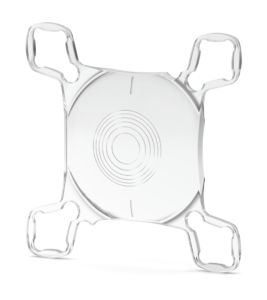
- Convex–concave optic creates ~500–600 μm clearance from the primary IOL, minimising IOL touch and interlenticular opacification.
- Square 6.0 mm optic with rounded edges helps prevent iris capture and pigment dispersion.
- Four closed-loop “4‑flex” haptics (13.0 mm overall) give four‑point fixation and excellent centration across a wide range of sulcus sizes.
- Hydrophilic acrylic (25% water) with UV absorber offers proven uveal biocompatibility.
These design features are common to the monofocal, toric, trifocal and trifocal toric AddOn® models.
Safety In The Sulcus
Across multiple clinical series, AddOn® lenses have shown:
- Stable IOP – no significant change compared with pre‑op, with pressures remaining in the physiological range.
- Minimal endothelial cell loss – typically around 2%, much lower than during primary phacoemulsification.
- Preserved anterior segment anatomy – OCT and gonioscopy show deep chambers and open angles after implantation.
- Very low complication rates – no reported patterns of dislocation, iris capture, clinically significant pigment dispersion or angle‑closure glaucoma when eyes are appropriately selected.
This profile is particularly important when operating on eyes that already have a premium or otherwise well‑functioning bag IOL.
Toric AddOn®: Proven Rotational Stability
For toric lenses, stability is critical; rotation quickly erodes astigmatic correction. The toric AddOn® has now been independently studied in several cohorts:
- In a long‑term series of 18 eyes, the mean absolute change in axis from surgery to final follow‑up was only 4.9° ± 3.7°, with no lenses requiring repositioning.
- In a head‑to‑head comparison with another widely used C‑loop toric sulcus IOL, the C‑loop design needed repositioning in around 62% of eyes. In contrast, no toric AddOn® lenses in that comparison required further surgery, and mean rotation remained low.
- A 22‑eye series using the monofocal toric AddOn® for residual astigmatism found:
- 82% of eyes with residual cylinder ≤0.50 D, 100% ≤1.00 D
- Mean absolute rotation of 3.2° ± 3.3° at 3 months
- Only two eyes (9.1%) required a single early repositioning, with stable alignment thereafter.
These data comfortably meet typical rotational stability benchmarks and compare favourably with older sulcus toric platforms.
Why so stable?
The four closed‑loop haptics provide symmetric, four‑point anchorage rather than the two‑meridian bracing seen in C‑loop designs, and the non‑torque geometry avoids “spring‑back” forces that can drive rotation.
Refractive Accuracy: Minimal Residual Error
Across AddOn® toric studies:
- The vast majority of eyes land within ±0.50 D of target spherical equivalent, and essentially all within ±1.0 D.
- Residual cylinder is typically ≤0.50 D in 80–90% of eyes and ≤0.75 D in nearly all.
- Vector analyses show correction indices close to 1.0, confirming that the intended astigmatic correction is being delivered in full.
More Than Toric: A True “Swiss Army Knife”
Beyond toric correction, the AddOn® family offers:
- Trifocal and trifocal toric AddOn® lenses providing full‑range vision and high spectacle independence in eyes with existing monofocal capsular bag IOLs.
- Refractive and refractive toric AddOn® options across wide power ranges for extreme ametropia and post‑keratoplasty or post‑vitrectomy cases.
- Planned dual‑lens strategies that separate distance correction (bag IOL) from presbyopia correction (sulcus trifocal), making multifocality fully reversible if future pathology or intolerance develops.
In each scenario, the same sulcus‑optimised platform underpins safety and stability.
Spectrum Ophthalmics is the distributor for the Medicontur 1stQ AddOn® range, including the toric AddOn® models highlighted here. We support surgeons with:
- Case selection and calculation advice
- Click here to view the calculator
- Injector compatibility and theatre logistics
- Education around dual‑lens and upgrade strategies
For surgeons facing higher patient expectations and increasingly complex pseudophakic eyes, the AddOn® – and especially its toric variants – offers a stable, evidence‑based way to get patients into their visual comfort zone.
If you’d like to discuss specific cases or learn more about availability and training, please contact the Spectrum Ophthalmics team.